
GDPR Compliant Cookie Policy in 2026: 7 Live Checks Before You Publish
Anyone evaluating gdpr compliant cookie policy in 2026 is really balancing operational risk, marketing ambition, and buyer trust at the same time. A policy page alone does not solve that problem; the workflow behind the site does.
The decision around gdpr compliant cookie policy usually turns on trust, conversion, and operational risk at the same time. The teams that get it right are the ones that test the live journey instead of relying on policy language alone.
A compliant page has to match the live banner, the live scripts, the live categories, the real third parties, and the real withdrawal path.
That is still where the official guidance points. GDPR Article 12 requires information in “clear and plain language.” Your Europe still says websites using consent-based cookies must give “clear and comprehensive information” and make it “as easy for your users to withdraw” consent as to accept it. The ICO still says cookie disclosures must be “clear and comprehensive” about your purposes, and Ireland’s DPC says the information in the cookie policy must describe the operator’s own deployment and use of cookies, not generic third-party wording.
If you want the closest companion reads first, start with these guides to gdpr cookie policy template, cookie policy example, and eu cookie banner. This page stays narrower. It is the gdpr compliant cookie policy review I would use this week before publishing one on a live EU-facing site.
If your team is trying to get gdpr compliant cookie policy under control without adding a heavyweight privacy stack, DataShyre can help. DataShyre focuses on consent and preference management that are easier to implement, easier to operate, and easier to trust on a live site. Start with DataShyre’s consent and preference management or book a demo.
If your starting point is a OneTrust export, a Cookiebot table, or an old legal template, DataShyre can help connect the written policy to the live runtime through consent management, data mapping, and implementation review. The hard part is rarely getting draft text. It is proving that the draft still describes the site users actually visit.

1. Treat the cookie policy as an operator-specific document, not a generic template
The first gdpr compliant cookie policy mistake is publishing a page that could belong to almost any website.
That is exactly what the DPC warns against.
Its current cookie FAQ says the information in the cookie policy or linked from the banner must reflect the website or app operator’s own deployment and use of cookies.
So before you publish a gdpr compliant cookie policy, ask whether the page actually describes:
- your own domains and templates;
- your own tracking categories;
- your own third-party providers;
- your own reject and withdrawal routes;
- your own current runtime behavior.
If the page could be swapped onto another business with only the logo changed, it is probably too generic to be compliant.
2. Name categories, purposes, providers, and duration clearly
A gdpr compliant cookie policy needs more than a soft paragraph about improving the user experience.
Your Europe still expects clear and comprehensive information about the cookies used on the site and their purpose. The ICO says the explanation must make the purposes clear and easily available.
In real deployments, a usable gdpr compliant cookie policy should help a person understand:
- which category a technology belongs to;
- what practical purpose it serves;
- whether you or a third party sets it;
- whether it is session-based or persistent;
- where the person can manage that choice later.
If the page hides behind broad labels like analytics, marketing, or functional without any real explanation, the policy is still too vague.
3. Keep the exempt-versus-optional split narrow and honest
This is where many gdpr compliant cookie policy pages drift away from the law and the live site at the same time.
Your Europe still distinguishes between cookies that are strictly necessary for an online service explicitly requested by the user and cookies that need consent first. That means a gdpr compliant cookie policy should not casually push optional tracking into the necessary bucket.
I would expect the page to separate at least:
- authentication, security, and session continuity;
- basket or form-completion support;
- analytics and measurement;
- advertising and retargeting;
- personalization;
- embedded third-party tools.
If ad-tech, profiling, or non-essential measurement keeps getting described as required for the site to function, the policy is not telling the truth cleanly enough.
4. Make the policy, banner, and runtime tell the same story
A gdpr compliant cookie policy cannot be judged from the page alone.
It has to match the first-layer banner and the live browser trace.
The ICO’s current guidance still says non-essential cookies cannot be set before consent, and the explanation given to users must be clear about what the technologies do and why they are there. That makes the most practical review very simple:
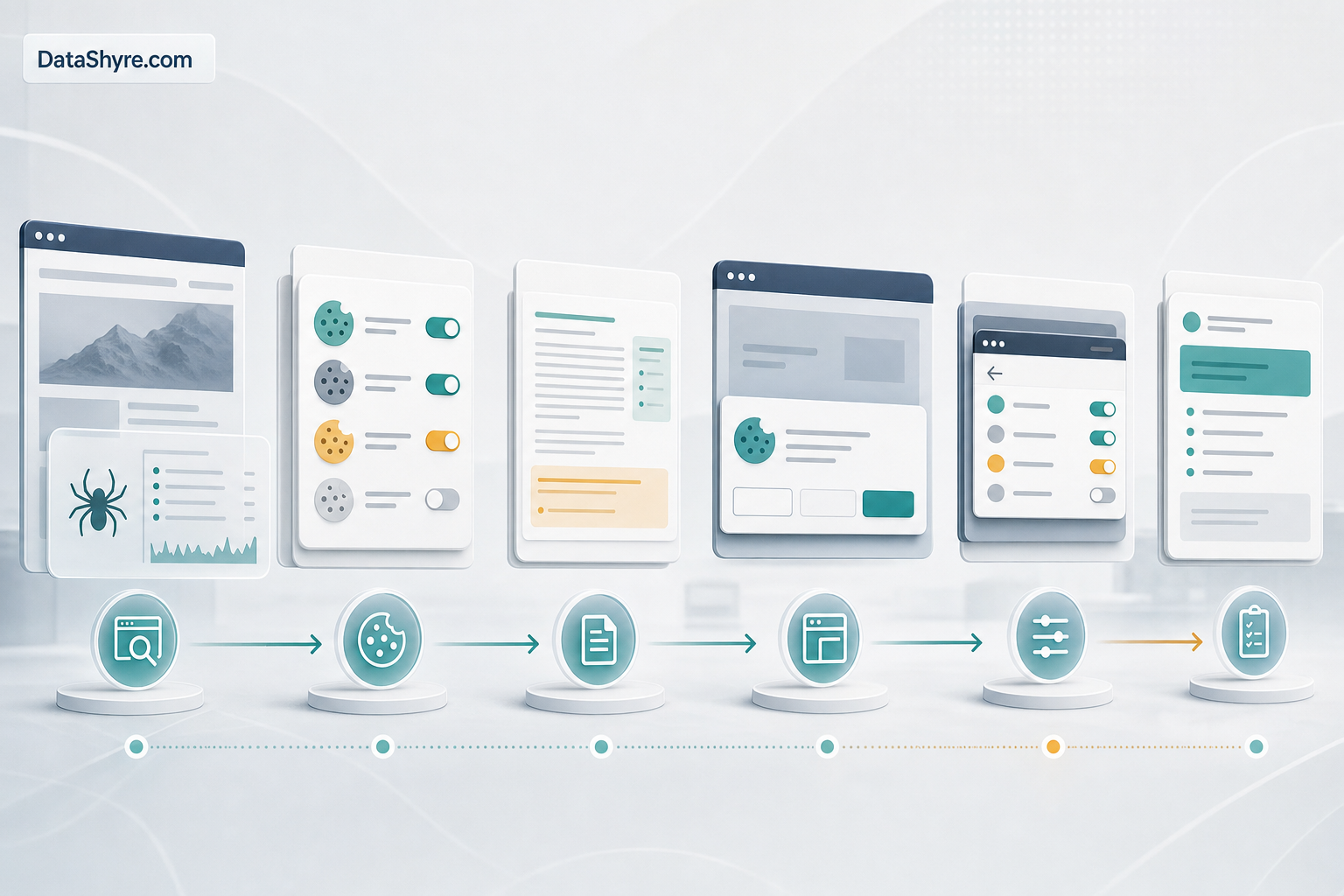
- load the site with no interaction;
- test
Reject all; - test
Accept all; - change preferences later;
- compare what actually fires against what the policy says.
If the policy promises refusal but the site still loads optional tags, pixels, or vendor scripts too early, the compliance problem is operational, not editorial.
This is also where DataShyre usually adds the most value. When the banner copy, vendor inventory, and runtime disagree, implementation cleanup matters more than another legal rewrite.
5. Make refusal and withdrawal easy, and describe them accurately
A gdpr compliant cookie policy should not only say users can change their minds.
It should reflect a route that really works.
Your Europe still says it must be as easy for users to withdraw consent as to accept cookies. The Commission’s guidance for individuals also says consent requests should be clear, concise, and distinguishable from other information such as terms and conditions.
So the policy should match a real path that lets users:
- refuse optional cookies up front where consent is required;
- revisit the settings later from a visible route;
- understand which categories change when they update preferences;
- avoid hunting through dense legal pages to undo a previous choice.
If the page says withdrawal is available at any time but the only route is buried, broken, or inconsistent across templates, the policy is overstating the control.
6. Cover more than classic browser cookies
One of the easiest ways to publish a weak gdpr compliant cookie policy in 2026 is to write as if the site only uses classic cookie files.
The ICO is explicit that the same rules can apply to other technologies that store or gain access to information on the user’s device. That means a strong gdpr compliant cookie policy often needs to account for more than a simple cookie table.
Depending on the stack, that can include:
- local or session storage;
- scripts and tags;
- pixels or beacons;
- embedded video, map, chat, or scheduler tools;
- other device-level technologies that support tracking or preference logic.
If the page only works for a simpler stack than the one the site actually runs, it is already falling behind reality.
7. Add update triggers so the policy stays compliant after launch
The biggest long-term gdpr compliant cookie policy risk is drift.
The page may be accurate on launch day and misleading a week later because:
- a new vendor is added through GTM;
- marketing enables a fresh ad-tech tag;
- a plugin update changes what loads by default;
- a new embed appears on a landing page;
- the CMP categories or defaults change.
A durable gdpr compliant cookie policy therefore needs a release trigger, not just a one-time review.
If a meaningful tracking change can ship without someone checking the banner, the runtime, and the policy together, the policy will age badly.
A practical GDPR compliant cookie policy review for this week
If I were auditing a gdpr compliant cookie policy today, I would do it in this order:
- inventory the live technologies on a clean page load;
- separate necessary functions from optional tracking;
- document category, purpose, provider, and duration;
- compare the policy against the banner and browser behavior;
- test refusal and later withdrawal;
- set a new review trigger before the next vendor or tag change.
That process tends to surface the truth faster than polishing wording first.
FAQ
What makes a cookie policy GDPR compliant?
A gdpr compliant cookie policy should describe the operator’s real technologies, purposes, providers, and control paths in clear language, and it should stay aligned with the site’s real behavior before and after consent choices.
Can I use CMP output as my cookie policy?
Sometimes as a draft, yes. But a CMP export on its own does not guarantee a gdpr compliant cookie policy because the DPC expects the policy to describe your own deployment and use of cookies, not generic third-party wording.
Does a GDPR compliant cookie policy only need to list cookies?
No. A strong gdpr compliant cookie policy often has to cover cookies plus other similar technologies such as tags, pixels, storage layers, and embedded third-party tools where they affect device-level tracking or preferences.
Bottom line
The best gdpr compliant cookie policy in 2026 is not the one with the most formal legal tone.
It is the one that matches the real site, uses clear language, explains the real categories and providers, reflects the real withdrawal path, and gets re-checked when the stack changes.
If the page does that, it helps.
For most teams, gdpr compliant cookie policy becomes easier to manage once it is treated as an operating decision instead of a one-time banner task.
Official sources used
- https://eur-lex.europa.eu/eli/reg/2016/679/oj/eng/
- https://commission.europa.eu/law/law-topic/data-protection/information-individuals_en
- https://europa.eu/youreurope/business/growing/digitalising/online-privacy/index_en.htm
- https://ico.org.uk/for-organisations/direct-marketing-and-privacy-and-electronic-communications/guide-to-pecr/cookies-and-similar-technologies/
- https://dataprotection.ie/en/faqs/cookies/what-are-common-problems-dpc-sees-websites-and-other-interfaces-controlling-use-cookies-and-tracking