
Privacy Policy Generators in 2026: 7 Live Checks Before You Shortlist One
Anyone evaluating privacy policy generators in 2026 is really balancing operational risk, marketing ambition, and buyer trust at the same time. A policy page alone does not solve that problem; the workflow behind the site does.
The decision around privacy policy generators usually turns on trust, conversion, and operational risk at the same time. The teams that get it right are the ones that test the live journey instead of relying on policy language alone.
That is where the current official guidance still points. The ICO says privacy information needs to be “simple to read” and “available to view” when people want it later. The California Privacy Protection Agency says the privacy policy should provide a “comprehensive description” of a business’s information practices and be posted through a link with the word “privacy” in it. GDPR Article 12 still requires privacy information to be presented using “clear and plain language.” And WordPress still says any starter text or helper output is your responsibility to keep “current and accurate.”
If you want nearby context first, start with these guides to best privacy policy generator, website privacy policy generator, and writing a privacy policy. This page stays broader. It is the privacy policy generators shortlist I would use this week before trusting any tool category to publish a live notice.
If your team is trying to get privacy policy generators under control without adding a heavyweight privacy stack, DataShyre can help. DataShyre focuses on consent and preference management that are easier to implement, easier to operate, and easier to trust on a live site. Start with DataShyre’s consent and preference management or book a demo.
If your team is comparing generators because the policy has already drifted away from the real stack, DataShyre can help with the harder layer around data mapping, consent management, and DSR automation. Most expensive privacy-policy mistakes come from the gap between the generated draft and the runtime reality.
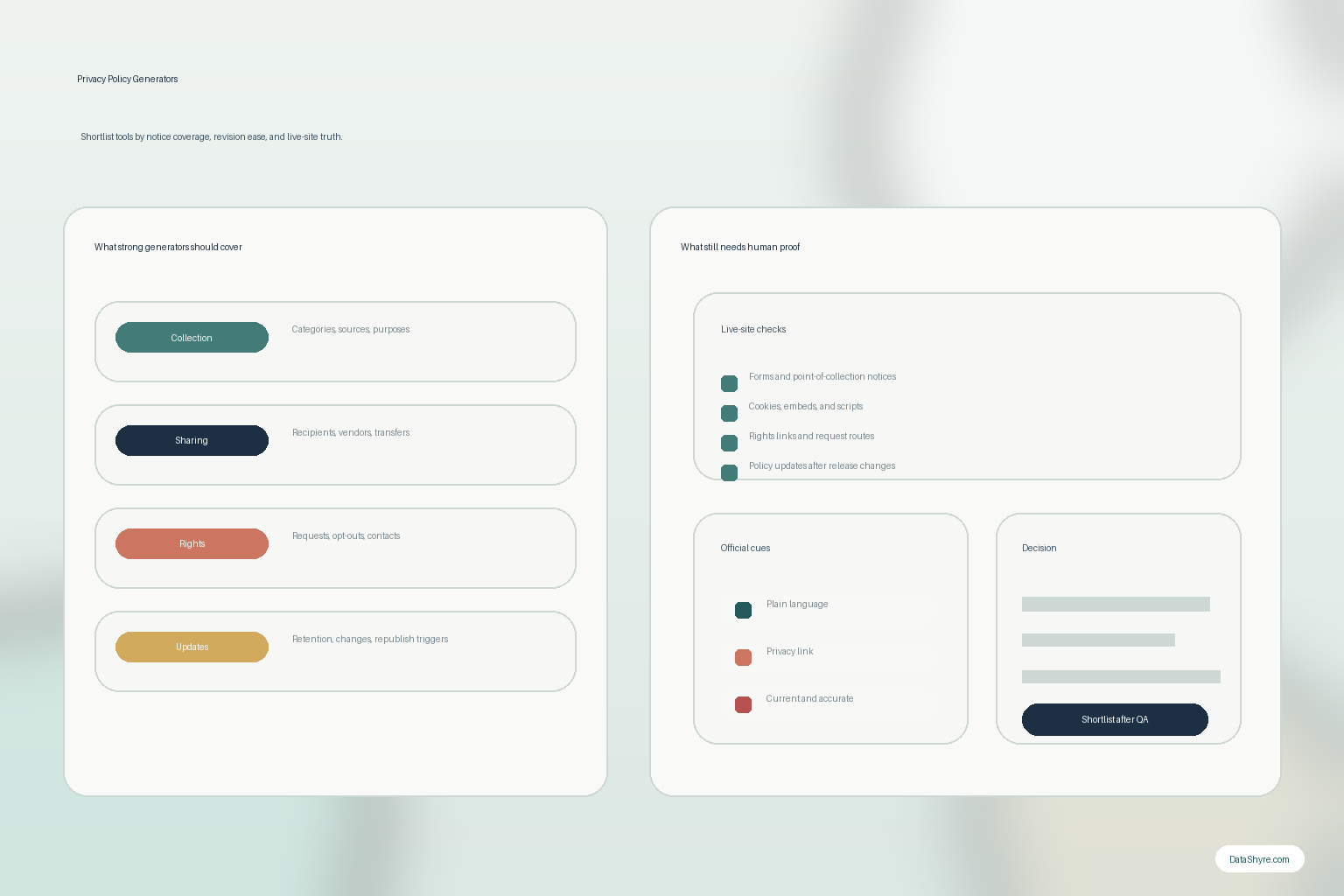
1. Shortlist generators by coverage, not by how polished the draft sounds
The first privacy policy generators mistake is ranking tools by how confident the text feels.
That is the wrong filter.
A polished generator can still miss the sections your final page needs to explain clearly.
For a real privacy policy generators shortlist, start with whether the tool can help your team document:
- categories of personal information;
- sources of that information;
- purposes for collection and use;
- categories of third parties or recipients;
- retention periods or retention logic;
- rights available to users and how to exercise them.
If the generator does not force those questions early, it is probably optimizing for speed more than for accuracy.
2. Treat the collection moment as part of the generator test
This is where many privacy policy generators look complete while still leaving the actual notice flow underspecified.
The CPPA’s current guidance says the Notice at Collection should appear at or before the point where personal information starts being collected, and it should link to the privacy policy. The ICO also says people should get the privacy notice when you first collect their personal details and be able to find it later.
So when reviewing privacy policy generators, do not ask only whether the final privacy-policy page looks usable.
Ask whether the output can be aligned with:
- contact and demo forms;
- newsletter signups;
- checkout, booking, or account-creation flows;
- app onboarding screens;
- any banner or preference-center route that also collects or infers personal information.
If the tool only helps with a footer page, the live notice path may still be weak.
3. Score generators on how well they survive cookies, embeds, and vendor drift
This is one of the fastest ways to separate useful privacy policy generators from decorative ones.
WordPress’s current privacy documentation is blunt about this. The built-in helper can collect text from WordPress core and participating plugins, but embedded third-party tools can still collect data in ways the helper cannot detect. That warning applies far beyond WordPress.
So a serious privacy policy generators review should test whether the draft can be tightened around:
- analytics, advertising, and session tools;
- chat, video, map, and scheduler embeds;
- CRM, email, and payment vendors;
- cookie and preference flows;
- third-party scripts added later through tag managers or plugins.
If the generator flattens those into generic phrases like trusted partners or service providers, the published policy will usually be too vague.
4. Prefer generators that make revision easy instead of hiding assumptions
The best privacy policy generators do not pretend they know your business perfectly.
They make it easy to inspect, edit, and republish the weak parts.
That matters because GDPR Article 12 still pushes the final result toward clarity, accessibility, and plain language. A draft that sounds legal but hides the underlying assumptions is harder to fix than a shorter draft that is transparent about what still needs human review.
When comparing privacy policy generators, I would look closely at whether the tool makes it easy to revise:
- controller or business identity details;
- vendor-specific disclosures;
- region-specific rights language;
- cookie and tracking explanations;
- retention and transfer wording after a stack change.
If editing the final text feels like fighting the product, the page will drift faster after launch.
5. Check whether the output creates a usable rights path, not just a rights paragraph
This is where the nicest-looking drafts often break.
The CPPA says the privacy policy should explain consumer rights, how to exercise them, and how opt-out preference signals are processed where relevant. The ICO also frames privacy information around helping people understand what happens to their data before they hand it over.
So a real privacy policy generators review should test whether the output helps a user answer:
- what rights may apply to me here;
- where do I submit the request;
- what link or form should I use;
- how do I change cookie or sharing preferences later;
- who do I contact if the automated path fails.
If the draft names rights but leaves the person guessing about the route, the generator did only half the job.
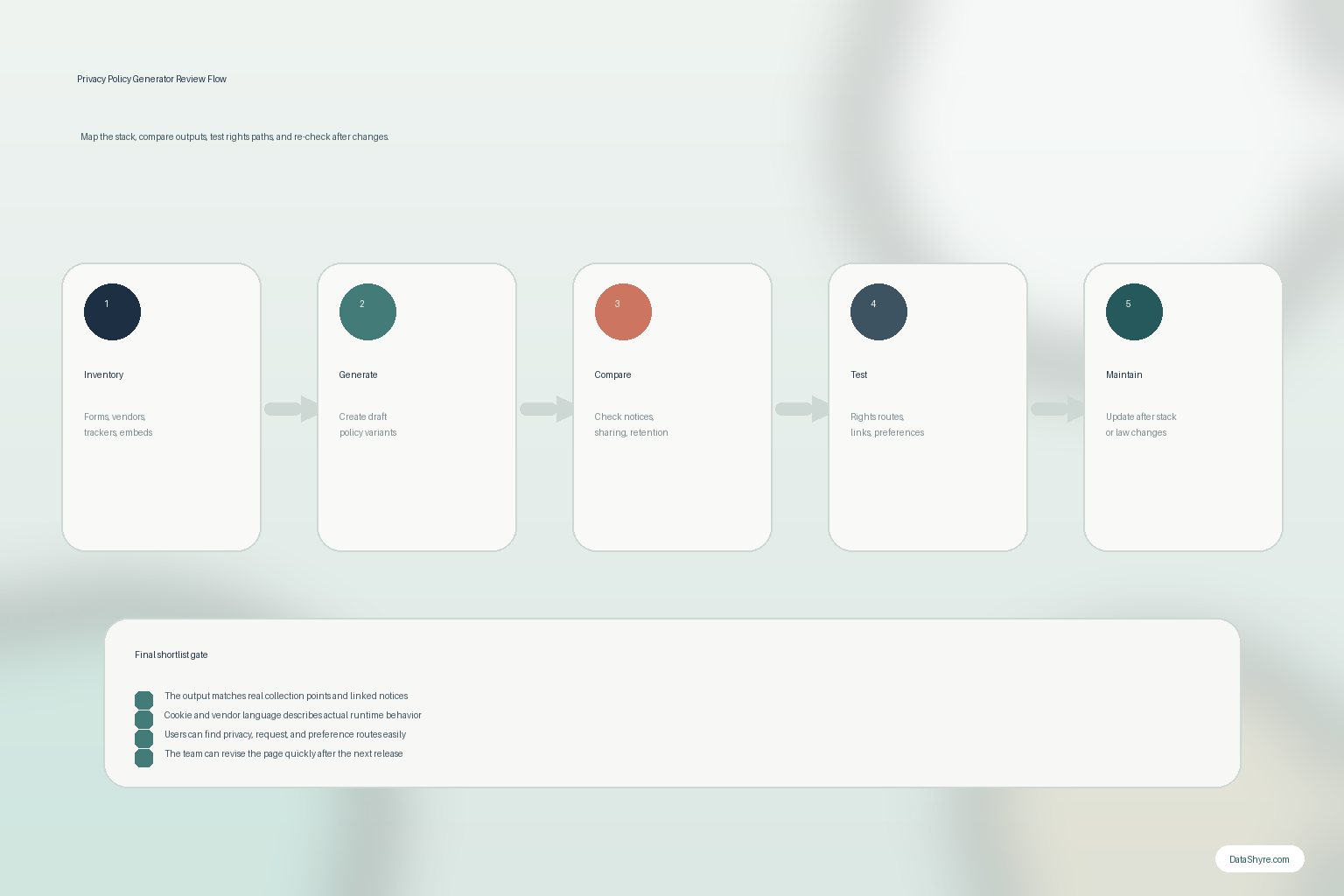
6. Do not confuse a generator with a compliance process
This is one of the clearest privacy policy generators checks in 2026.
WordPress says privacy helpers are not a compliance process in and of themselves. The product may give you a start, but it remains your responsibility to write a comprehensive policy and keep it accurate.
That is the right way to think about the whole privacy policy generators category.
The generator can help with:
- initial structure;
- baseline disclosures;
- section ordering;
- starter language for rights and contacts.
But it cannot verify on its own:
- what the live site actually loads;
- whether the cookie banner and privacy page tell the same story;
- whether request forms work;
- whether a new vendor quietly changed the disclosure picture.
If your team needs help in that gap between draft and deployment, that is exactly the implementation layer where DataShyre adds the most value.
7. Choose the generator your team will actually maintain after release changes
The long-term privacy policy generators risk is not the first draft.
It is neglect.
The ICO says privacy notices should be reviewed regularly to make sure they stay up to date. WordPress says the final policy needs to stay “current and accurate.” California’s notice guidance also expects the privacy policy to show when it was last updated.
So the most useful privacy policy generators are the ones your team can realistically revisit when:
- a new vendor or processor is added;
- forms or checkout flows change;
- the site adds new tracking or embeds;
- retention practices change;
- the business expands into a new region or new rights regime.
If the generator makes revisions painful, the page will age badly even if the original draft looked good.
A practical shortlist for this week
If I were narrowing privacy policy generators today, I would score them in this order:
- coverage for categories, purposes, recipients, retention, and rights;
- fit with real point-of-collection notices;
- ability to describe cookies, embeds, and vendors honestly;
- ease of human revision;
- clarity of request and preference routes;
- how easy the output is to keep aligned after releases.
That scorecard usually reveals more than the marketing demo.
FAQ
Are privacy policy generators enough on their own?
No. Privacy policy generators can speed up drafting, but they do not verify live forms, hidden fields, scripts, vendors, or rights workflows on their own.
What should I compare first when shortlisting privacy policy generators?
Start with disclosure coverage and how easily the draft maps to real collection points, cookies, vendors, and request routes on your site.
Do privacy policy generators replace cookie or consent tools?
No. A generator can help explain the privacy story, but the runtime control layer around banners, preferences, and opt-outs usually needs separate testing and often separate tooling.
Bottom line
The best privacy policy generators in 2026 are not the ones that produce the most impressive first draft.
They are the ones that make it easiest for your team to close the gap between generated language and real behavior across notices, trackers, rights routes, and release changes.
If that gap stays small, the generator helped.
For most teams, privacy policy generators becomes easier to manage once it is treated as an operating decision instead of a one-time banner task.