
WordPress GDPR Compliance in 2026: 7 Live Checks Before You Call the Site Ready
Anyone evaluating wordpress gdpr compliance in 2026 is really balancing operational risk, marketing ambition, and buyer trust at the same time. A policy page alone does not solve that problem; the workflow behind the site does.
The decision around wordpress gdpr compliance usually turns on trust, conversion, and operational risk at the same time. The teams that get it right are the ones that test the live journey instead of relying on policy language alone.
WordPress GDPR compliance is a live-operations problem. It sits across your privacy notice, your cookie behavior, your plugins and embeds, your rights workflow, and the release process that changes all of those pieces after launch.
The current official sources all push in that direction. WordPress says its privacy tools can help, but it is still your responsibility to keep the final policy “current and accurate.” WordPress also warns that its export path “ONLY gathers data from WordPress and participating plugins,” which means outside services may still sit beyond the default workflow. The Plugin Handbook says a plugin that collects, uses, stores, or passes user data to a third party “should add a section of suggested text” to the privacy policy guide. The ICO’s current cookies guidance still says you “cannot set non-essential cookies” before the user has consented. And on March 19, 2026, the EDPB launched its coordinated enforcement action for 2026 on “transparency and information obligations” under GDPR Articles 12, 13, and 14.
That is the right frame for wordpress gdpr compliance in late 2026.
The question is not did we install the right plugin.
It is does the live WordPress stack tell the truth about data use, respect user choices, support rights requests, and stay accurate after the next change.
If you want nearby context first, start with these guides to GDPR for WordPress, GDPR WordPress plugin, and WordPress cookie notice. This page stays broader. It is the wordpress gdpr compliance review I would run this week before telling a team their site is ready.
If your team is trying to get wordpress gdpr compliance under control without adding a heavyweight privacy stack, DataShyre can help. DataShyre focuses on consent and preference management that are easier to implement, easier to operate, and easier to trust on a live site. Start with DataShyre’s consent and preference management or book a demo.
If your team needs help connecting WordPress privacy surfaces to the systems behind them, DataShyre can help with consent management, data mapping, and DSR automation. The hard part is rarely the plugin install. It is keeping the policy, runtime behavior, and proof aligned after each release.

1. Start with the real data map, not the settings screen
The first wordpress gdpr compliance failure happens when the team audits toggles before it audits the actual site behavior.
That is backwards.
WordPress says the privacy helper can collect starter text from core, themes, and participating plugins, but it also says many sites use third-party tools the helper cannot fully detect automatically.
So before you judge compliance, inventory the live collection points:
- forms for demos, support, checkout, and newsletters;
- login, registration, and account pages;
- analytics, ads, pixels, and tag-manager paths;
- chat, video, map, calendar, and payment embeds;
- CRM, email, and support tools connected behind the form.
If that inventory is incomplete, the rest of the wordpress gdpr compliance review is mostly theater.
2. Treat the privacy-policy helper as a draft, not a finished notice
WordPress ships useful privacy tooling.
Useful is not the same as complete.
The current WordPress privacy documentation says the helper is there to give you a start, not to replace your own analysis. It also says every site administrator should understand what data the website actually collects and should be transparent about what really happens.
That matters because the broad wordpress gdpr compliance failure is not usually no policy at all.
It is a policy that sounds polished while missing:
- third-party embeds and SaaS tools;
- analytics and ad tags that fire outside core;
- retention details that operations teams handle elsewhere;
- actual rights-contact routes and response steps;
- regional differences between EU and non-EU journeys.
If your notice reads like a template but your stack behaves like a patchwork, the policy is the weakest kind of protection: confident and wrong.
3. Test cookie behavior before you trust the banner copy
This is the most common wordpress gdpr compliance blind spot.
Teams inspect the banner text and never test what the page loads before consent.
The ICO’s current guidance is still blunt: you “cannot set non-essential cookies” before the user has consented. It also says users should have an easy way to enable or disable non-essential cookies.
That means a real wordpress gdpr compliance check needs runtime testing for:
- analytics tags that fire on first paint;
- marketing pixels injected by themes, plugins, or tag managers;
- embedded media that drops cookies before a click;
- reject-all and withdraw-consent behavior after the page is already live;
- mobile behavior, not only the desktop path.
If your team is comparing banner tooling, our cookie banner guide is the narrower companion read. If the consent layer is already messy, DataShyre can help implement a cleaner consent management setup that matches the policy and the live scripts.
4. Verify export and erasure on the systems people actually use
WordPress deserves credit here.
Its built-in export and erasure tools are practical.
But WordPress also tells you where the boundary is. The privacy documentation says the export path “ONLY gathers data from WordPress and participating plugins.” The erase-tool documentation adds another operational warning: it “does not remove the data from backups or archive files.”
That means a serious wordpress gdpr compliance review should test:
- whether your key plugins register exporter and eraser support;
- whether third-party tools still hold the same user data after a request is closed;
- whether backup and restore procedures could quietly reintroduce erased data;
- whether the request log shows who handled the request, when, and what systems were included;
- whether verified requests are easy for staff to complete without improvising.
If your rights workflow stops at the WordPress dashboard while the real customer data lives in a CRM, ESP, scheduler, and support stack, you do not have a complete response path.
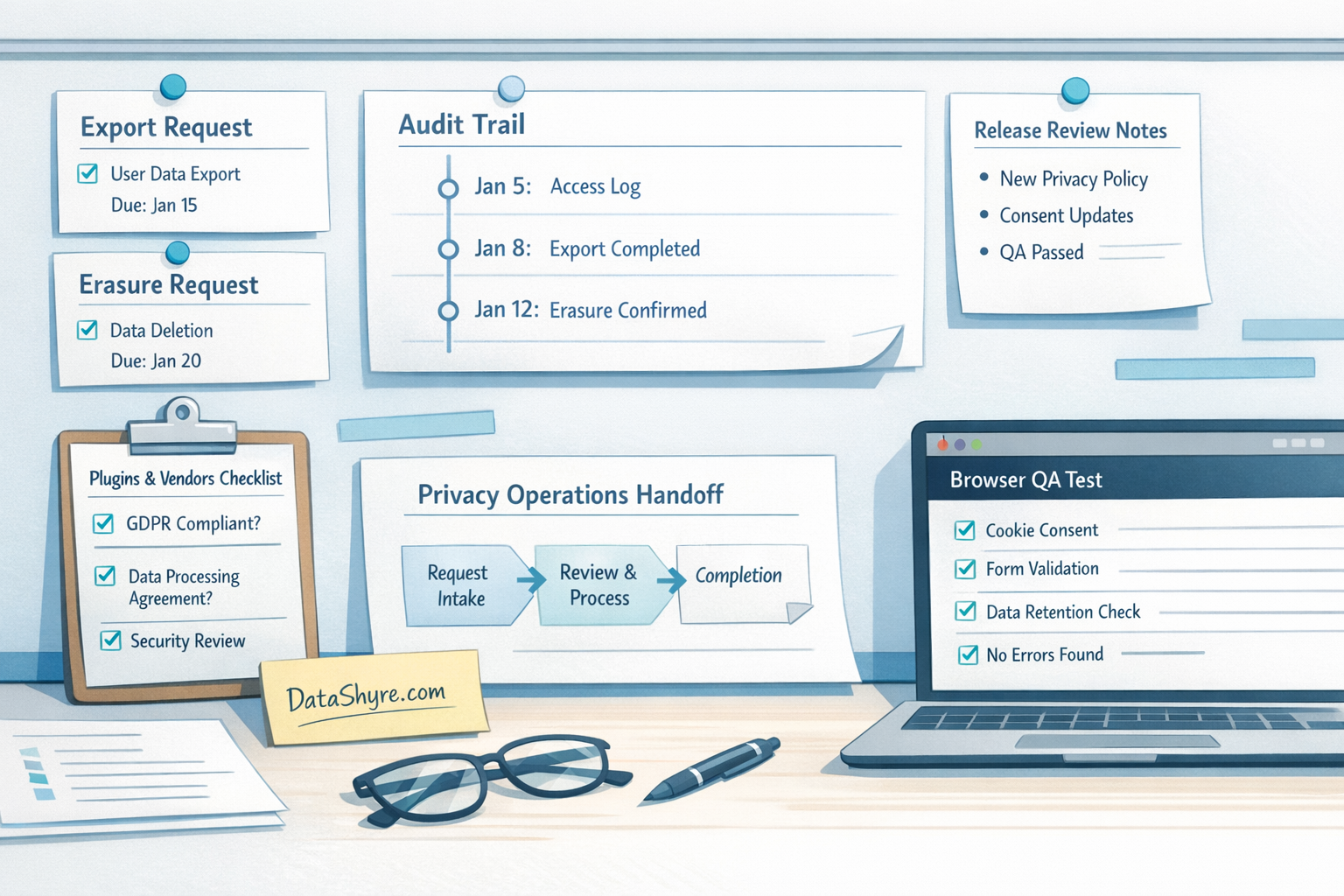
5. Audit plugins, themes, and vendors as processors, not just features
Many wordpress gdpr compliance reviews still ask the wrong question:
what features does this plugin add
The better question is:
what personal data does this plugin or vendor touch, where does it send it, and under what terms
The European Commission’s current GDPR business guidance says a processor must provide “sufficient guarantees” and be bound by a contract or other legal act.
For a practical pass, review:
- what each plugin, theme, or SaaS integration collects;
- whether it passes data to another vendor or SDK;
- whether the privacy notice actually discloses that behavior;
- whether the vendor paperwork, settings, and live runtime all match;
- whether any old inactive plugin is still leaving code, cookies, or endpoints behind.
Feature comparisons are easy. Data-flow comparisons are the real work.
6. Use release governance so the site stays compliant after launch
This is where otherwise careful teams lose the plot.
They review privacy once, then treat the result like a permanent status.
It is not.
WordPress sites change through plugin updates, marketing experiments, embed swaps, new form fields, CRM integrations, and theme edits. Any one of those can change the answer to basic notice or consent questions.
A stronger wordpress gdpr compliance workflow ties privacy review to release review:
- new plugin or script means new data-flow review;
- new form field means new notice and retention review;
- new embed means new cookie and third-party disclosure test;
- new campaign or tag-manager publish means new pre-consent runtime check;
- any material change means the live policy and rights workflow get rechecked.
This is also why the EDPB’s 2026 focus on “transparency and information obligations” matters operationally. Transparency is not only about having a page. It is about that page staying accurate when the site changes underneath it.
7. Keep proof that survives staff changes and future audits
The final wordpress gdpr compliance check is boring, which is exactly why it matters.
Keep proof.
Keep it somewhere the next admin, agency, or privacy lead can actually use.
Useful proof usually includes:
- the current plugin and embed inventory;
- screenshots or test captures for accept, reject, and withdraw flows;
- the current privacy notice and change log;
- request-handling runbooks for export, erasure, and vendor follow-up;
- vendor and processor records tied to the live stack.
Without that proof, the site may feel compliant only because the people who remember the setup are still around.
The practical answer
If you want the shortest honest answer to wordpress gdpr compliance in 2026, it is this:
WordPress can help.
Plugins can help.
But compliance only starts to look real when the notice, the banner, the scripts, the plugins, the vendors, and the rights workflow all describe the same live system.
For most teams, wordpress gdpr compliance becomes easier to manage once it is treated as an operating decision instead of a one-time banner task.
Sources
- WordPress.org Documentation, WordPress Privacy: https://wordpress.org/documentation/article/wordpress-privacy/
- WordPress.org Documentation, Tools Erase Personal Data screen: https://wordpress.org/documentation/article/tools-erase-personal-data-screen/
- WordPress Plugin Handbook, Suggesting text for the site privacy policy: https://developer.wordpress.org/plugins/privacy/suggesting-text-for-the-site-privacy-policy/
- ICO, Cookies and similar technologies: https://ico.org.uk/for-organisations/direct-marketing-and-privacy-and-electronic-communications/guide-to-pecr/cookies-and-similar-technologies/
- European Data Protection Board, CEF 2026 transparency and information obligations action: https://www.edpb.europa.eu/news/cef-2026-edpb-launches-coordinated-enforcement-action-on-transparency-and-information_sl
- European Commission, Application of the GDPR: https://commission.europa.eu/law/law-topic/data-protection/information-business-and-organisations/application-gdpr_en