
How to Comply with GDPR in 2026: 8 Practical Checks for Real Teams
Anyone evaluating comply with gdpr in 2026 is really balancing operational risk, marketing ambition, and buyer trust at the same time. A policy page alone does not solve that problem; the workflow behind the site does.
The decision around comply with gdpr usually turns on trust, conversion, and operational risk at the same time. The teams that get it right are the ones that test the live journey instead of relying on policy language alone.
You get closer when your purposes, lawful bases, notices, vendors, rights handling, and security controls all describe the same live reality.
That is also where the current official sources keep pointing. On March 19, 2026, the European Data Protection Board launched its 2026 Coordinated Enforcement Framework on “transparency and information obligations”. GDPR Article 12 still requires information to be given in “clear and plain language”. Article 5 still says the controller must “be able to demonstrate compliance”. The European Commission’s current business guidance still says processors must provide “sufficient guarantees” and be bound by a contract or other legal act. Article 35 still requires a DPIA when processing is “likely to result in a high risk” to people.
If you want nearby companion reads first, start with these guides to gdpr requirements, gdpr compliant, and website privacy checker. This page stays broader. It is the operating checklist I would use this week if a team asked how to comply with gdpr without hiding behind boilerplate.
If your team is trying to get comply with gdpr under control without adding a heavyweight privacy stack, DataShyre can help. DataShyre focuses on consent and preference management that are easier to implement, easier to operate, and easier to trust on a live site. Start with DataShyre’s consent and preference management or book a demo.
If your team needs help connecting consent, notices, data mapping, and runtime implementation, DataShyre can help with consent management, data mapping, and DSR automation. The expensive failures are usually mismatch failures, not wording failures.
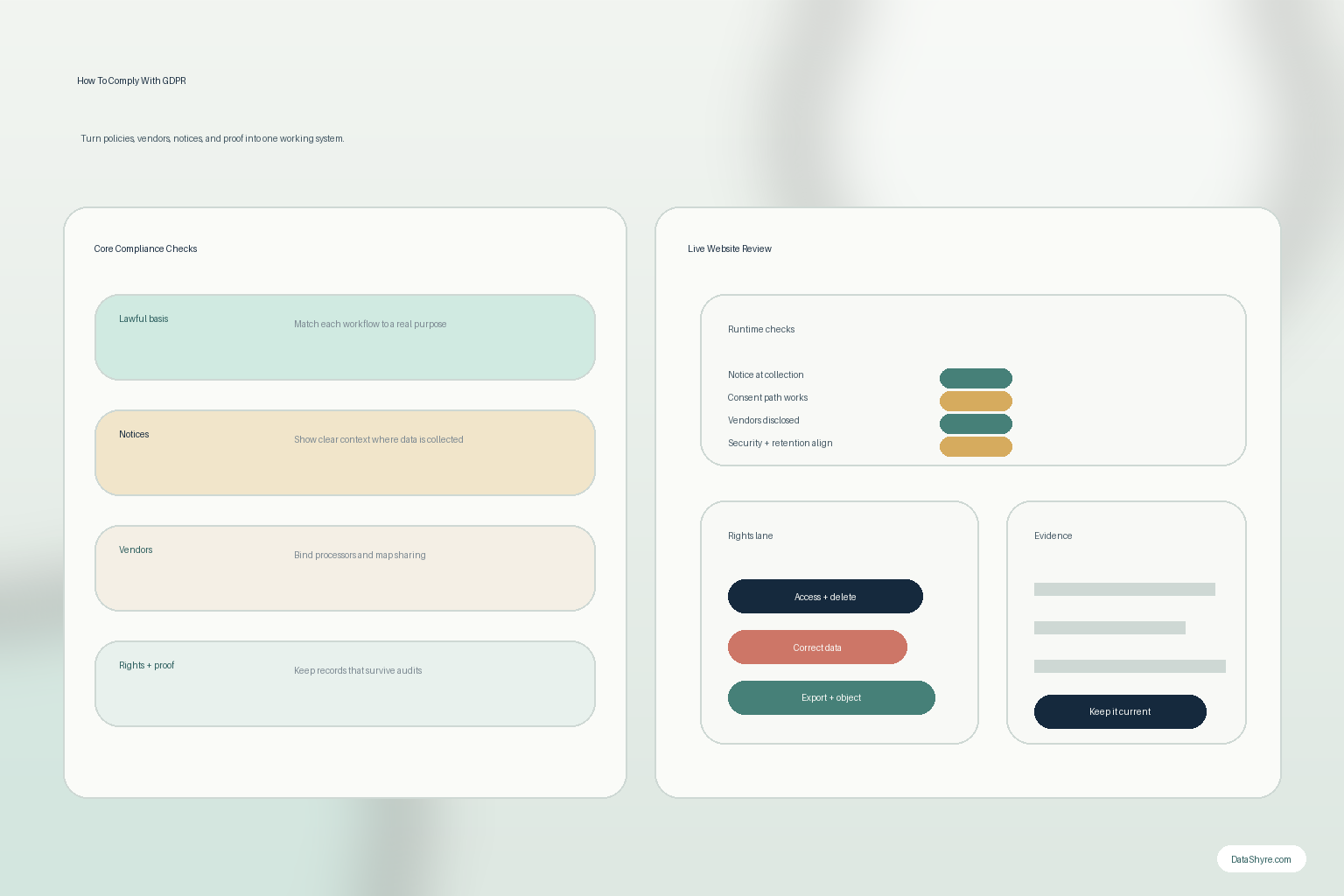
1. Start with the real processing, not the policy draft
The first comply with gdpr mistake is starting from the privacy policy template instead of the live stack.
GDPR applies to processing, not to marketing language about processing.
That means the first useful pass is a map of:
- the forms, app flows, pages, and support channels where personal data is collected;
- the categories of personal data involved;
- the business purposes behind each use;
- the internal teams and outside vendors that touch the data;
- the retention periods or decision rules that control how long the data stays.
If your team cannot explain where the data enters, where it goes, and why it is there, almost every other GDPR artifact becomes brittle.
This is also why so many organizations think they are close when they are not. The policy may look polished, but the real collection points, trackers, CRM automations, exports, and vendor syncs tell a different story.
2. Match each workflow to a lawful basis you can defend
The second comply with gdpr mistake is treating lawful basis like a sentence to paste into a notice.
It is a decision you need to make per workflow.
For a practical review, ask:
- what exact processing is happening;
- why it is necessary;
- which lawful basis under Article 6 actually fits;
- whether special category data or employee data changes the analysis;
- whether the basis used in the notice matches what the product and operations teams are really doing.
This matters because consent is not the universal answer. Sometimes the right basis is contract performance, legal obligation, or legitimate interests. Sometimes consent really is the right answer, especially for optional marketing or non-essential tracking. The point is to stop using one label for everything.
When teams skip this, the phrase comply with gdpr turns into guesswork. The better path is boring and specific: line up each use case with one defensible basis, record it, and make sure the surrounding copy and controls agree with it.
3. Fix the notice where data is collected, not only in the footer
The EDPB’s 2026 coordinated action is a useful reminder that transparency is still not solved.
A real comply with gdpr review checks whether people understand the processing when it matters, not only after they hunt through the site.
That means checking whether:
- a short notice or explanation appears at the form, signup, upload, or checkout step;
- the full policy is easy to reach on desktop and mobile;
- the short notice and the full notice match;
- purposes, recipients, transfers, and retention are described in usable language;
- changes in tooling trigger a notice review instead of silently drifting.
This is where Article 12’s “clear and plain language” standard becomes practical. If your wording only makes sense to counsel, the notice is weak even before anyone debates the lawful basis.
If this is the part breaking down, our privacy policy template guide is the narrower next step.
4. Control processors before the data leaves your systems
Many teams say they want to comply with gdpr but still approve vendors through procurement or engineering without a real processor review.
That is risky because the vendor layer is where data handling often becomes least visible.
The European Commission’s business guidance keeps the controller-processor split clear: controllers decide the purposes and means, processors act on behalf of the controller, and processors need “sufficient guarantees” plus a binding contract.
So a useful vendor pass asks:
- which providers act as processors, joint controllers, or independent controllers;
- whether the contract covers subject matter, duration, nature, purpose, data types, and categories of people;
- whether subprocessors are visible and governed;
- whether transfer mechanisms and locations are documented;
- whether the vendor can actually help with access, deletion, correction, objection, or restriction workflows when needed.
If the only evidence is a signed order form and a sales deck, the comply with gdpr story is probably thinner than the policy page suggests.
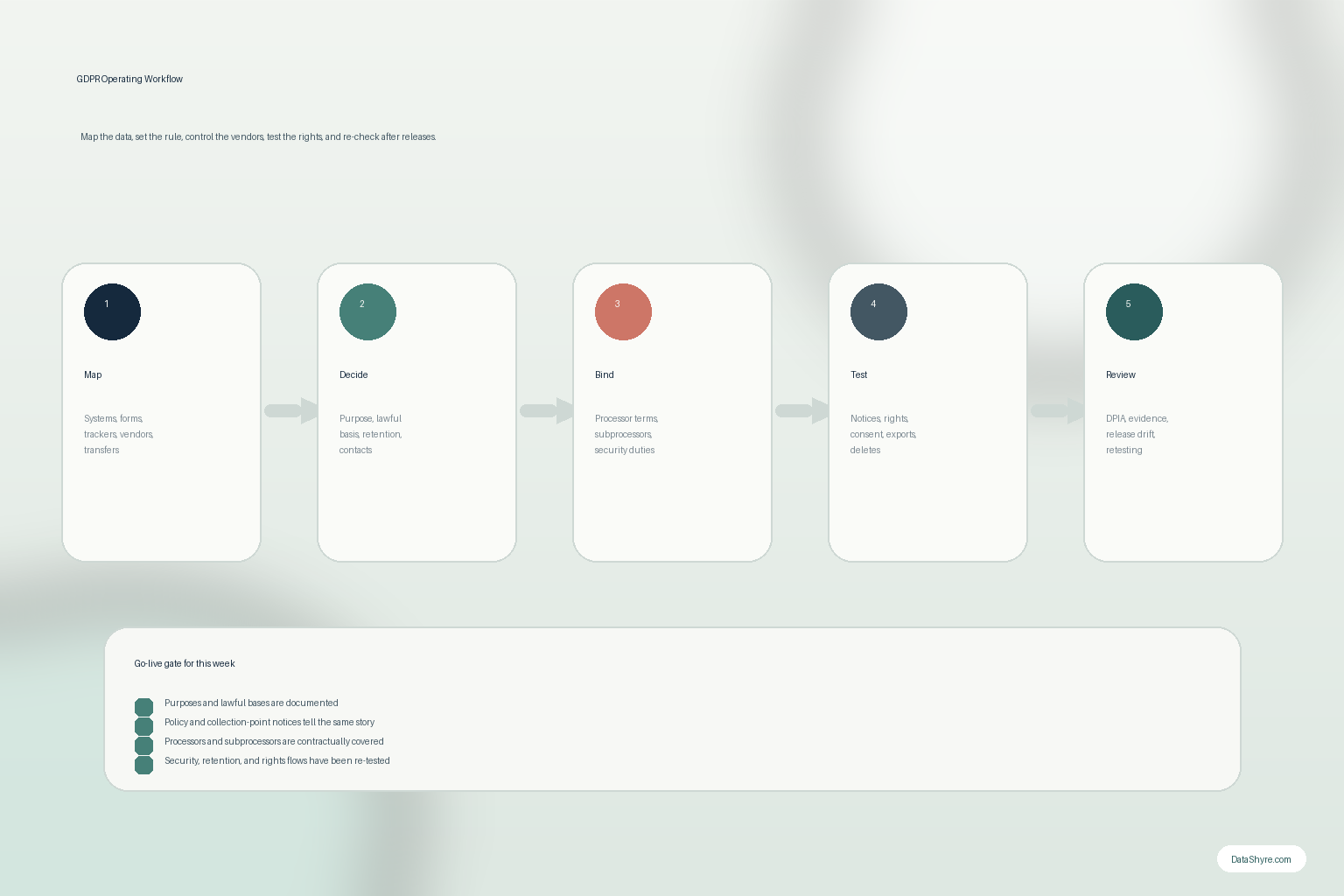
5. Keep records that explain what is happening now, not six months ago
The accountability problem in GDPR is usually not a missing sentence. It is stale evidence.
To comply with gdpr, your records should help answer ordinary operational questions quickly:
- what categories of data are we processing;
- for which purposes;
- under which lawful bases;
- which recipients or vendors receive the data;
- how long does it stay;
- which security measures and review points apply.
This is where records of processing activities become useful rather than ceremonial. They are not just for the regulator. They are the working map that lets the privacy page, DSR workflow, security controls, and vendor instructions stay consistent.
The biggest sign of trouble is drift. Marketing adds a tool. Product adds a new field. Operations changes a retention job. Nobody updates the records. A month later the site, policy, and contracts are describing three different businesses.
6. Use DPIAs and privacy-by-design before the risky launch, not after
GDPR Article 35 still matters because it forces teams to slow down on higher-risk processing before it goes live.
If a project is “likely to result in a high risk” to the rights and freedoms of natural persons, the controller needs to assess that risk in advance.
For a real comply with gdpr workflow, that usually means stopping to review projects such as:
- large-scale tracking or profiling;
- sensitive or special-category data uses;
- major behavioral analytics changes;
- automated decision flows with meaningful consequences;
- new integrations that expand sharing, retention, or cross-border movement.
The point of a DPIA is not to create another PDF graveyard. It is to make design, engineering, legal, and operations teams decide what will actually reduce the risk before launch.
7. Test rights handling like a product flow
A lot of teams claim they comply with gdpr because they have an email alias for requests.
That is not enough.
You need to know whether access, deletion, correction, objection, restriction, and portability requests can be recognized, routed, fulfilled, and evidenced across the real systems that hold the data.
The practical review questions are:
- can the intake path identify the person reliably without collecting more than necessary;
- do internal owners know which systems need to be checked;
- can vendors support the request in time;
- is the response templated but still specific enough to be accurate;
- can you show what was done if someone asks later.
This is where privacy work becomes operational instead of decorative. If a rights request hits your stack tomorrow, the answer should not depend on who happens to be awake in Slack.
8. Re-test security, retention, and runtime behavior after every meaningful change
GDPR compliance does not stay true just because it was true once.
Article 32 still requires security measures appropriate to the risk. In real deployments, that means the technical and organizational controls need to keep up with the stack you actually run now.
For comply with gdpr, re-test after changes to:
- vendors or subprocessors;
- forms and account flows;
- analytics or ad-tech tags;
- retention jobs and deletion logic;
- permissions, exports, backups, and support tooling.
This is also why release governance matters more than annual policy refreshes. The best GDPR programs do not rely on one heroic quarterly clean-up. They build review triggers into launches, procurement, and change management.
The short version
To comply with gdpr in 2026, do not ask only whether the company has a policy, banner, DPA, or template.
Ask whether the live system can prove all of these at once:
- the purpose for each meaningful processing path is known;
- the lawful basis fits the reality of that path;
- the notice explains the processing where people encounter it;
- processors are governed and visible;
- records stay current;
- risky projects get a real pre-launch review;
- rights requests work across the full stack;
- security and retention controls are re-tested when the system changes.
That is the version of comply with gdpr that survives real growth, real releases, and real regulator questions.
Is GDPR compliance mainly a legal writing project?
No. Legal text matters, but most failures happen because the live processing, vendor setup, notice wording, and rights workflow drift apart.
Can a CMP or privacy tool make you compliant by itself?
For most teams, comply with gdpr becomes easier to manage once it is treated as an operating decision instead of a one-time banner task.