
Google Analytics Cookie Consent in 2026: 8 Live Checks Before GA4 Fires
Anyone evaluating google analytics cookie consent in 2026 is really balancing operational risk, marketing ambition, and buyer trust at the same time. A policy page alone does not solve that problem; the workflow behind the site does.
The linked DataShyre guides help with the broader policy context, but the real business decision still comes down to whether the live site behavior matches the promises made on the page.
That is the sharper frame now. The European Commission still says valid consent must be tied to a clear affirmative act and that withdrawal should be “as easy to use as giving consent.” The ICO’s final 2026 storage-and-access guidance also matters because it reaches beyond old-fashioned cookies and explains that some narrow exceptions require a “simple means of objecting.” Google’s current developer guidance still says default consent should be set “before any commands that send measurement data” such as config or event.
If you want nearby implementation context first, start with these guides to Google Tag Manager cookie consent, GA4 consent mode, and cookie consent. This page is narrower. It is the eight-check review I would run this week before trusting google analytics cookie consent on a live site.

1. Map the real analytics surface before you judge the banner
Most teams asking about google analytics cookie consent are not reviewing one script.
They are reviewing a stack:
- GA4 loaded directly or through Google Tag Manager;
- Google Ads or remarketing connections;
- embedded video, chat, testing, or session tools that add their own storage;
- plugins or hard-coded snippets that survive theme or container changes.
That matters because a clean banner can still hide a messy runtime. If one plugin writes analytics-related storage before consent, or one custom tag fires outside the CMP path, the user-facing notice is no longer the whole truth.
2. Separate EU or EEA consent analysis from the UK’s narrow analytics exception
This is where many cookie-consent articles still blur the answer.
For EU or EEA traffic, the familiar baseline remains: consent should be freely given, specific, informed, and expressed through a clear affirmative act where consent is the legal path. For UK traffic, the ICO’s current guidance describes a narrow statistical purposes exception. But the same guidance also says the exception is purpose-specific, requires clear information, and requires a simple means of objecting free of charge.
That means the better question is not whether GA4 is globally exempt.
It is whether your exact UK use case is genuinely limited to narrow statistical purposes, or whether the same setup also supports advertising, profiling, cross-tool sharing, or another purpose that pushes you back toward consent.
For many commercial sites, especially where GA4 is connected to advertising or broader measurement workflows, that review still leads back to consent.
3. Treat consent mode as runtime control, not legal cover
Google’s own wording is useful here: “Consent mode does not provide a consent banner or widget.”
That line matters because teams still expect consent mode to solve the whole problem by itself.
It does not.
Consent mode is the runtime mechanism that lets Google tags react to a user’s consent state. The legal sufficiency still depends on the surrounding notice, the choice design, the regional logic, and what the page actually does before and after the user decides.
So a healthy google analytics cookie consent setup should be able to explain both layers:
- why the consent model is valid for the region and use case; and
- how the technical controls enforce that model in the browser.
4. Verify that denied defaults are set before measurement starts
This is the most important technical check in the Google stack.
Google’s current setup guidance says the default consent state should be called on every page before any commands that send measurement data. It also says consent updates should be tracked on the page where they occur before any page transition.
So a real google analytics cookie consent audit should test this exact sequence:
- a first visit loads with denied defaults where required;
- GA4 or related Google tags do not jump ahead of those defaults;
- the visitor makes a choice;
- the consent update reaches the page on the same interaction;
- later page loads honor the stored state.
If defaults are set too late, the banner may look compliant while the measurement layer races ahead.
5. Test the denied state, not just the accepted state
Many teams validate only the happy path.
Someone clicks Accept all, dashboards fill up, no obvious errors appear, and the review ends.
That is not where the interesting risk lives.
Google’s current consent mode overview says that when consent for storage is denied, Google tags and SDKs limit data collection, may avoid writing cookies for the denied storage types, and can use modeling to fill some reporting gaps. That can preserve useful measurement. It does not replace the need to test what still happens in the browser.
A better google analytics cookie consent review starts with refusal:
- reject first;
- inspect what GA4 still sends;
- confirm which storage stays off;
- check whether a non-Google script still behaves like analytics anyway;
- repeat after a container publish, plugin change, or template update.
That is usually where hidden consent drift shows up.
6. Check linked Google services for ad_user_data and ad_personalization
This is one of the most useful live Google details in 2026.
Google Analytics Help now explains that if a GA4 property is linked to another Google service that requires consent to share data, and one or more data streams have EEA-based visitors, Analytics may notify you when it is not receiving affirmative end-user consent for ads measurement or ads personalization.
Google ties those checks to the consent mode parameters ad_user_data and ad_personalization.
That means google analytics cookie consent does not always begin and end with analytics_storage. If your property is connected to Google Ads, remarketing, imported conversions, or similar linked-service workflows, you should test that branch separately instead of assuming the analytics setting covers everything.
7. Account for Google’s June 15, 2026 data-controls change
This is the newer Google detail most older articles still miss.
Google’s current Analytics help says that starting June 15, 2026, the Google Signals setting in Google Analytics admin and the Google Signals API controls association of Analytics-sourced data with signed-in user information for behavioral reporting, while the Consent Mode ad_personalization setting controls whether that data is used for personalization in Ads.
That matters because some teams still read old Google Signals settings as if they settle the advertising branch.
In current practice, a serious google analytics cookie consent review should ask:
- what the GA4 property is linked to;
- whether
analytics_storage,ad_user_data, andad_personalizationare all being handled correctly where required; - whether internal documentation still reflects pre-June-2026 assumptions.
8. Make refusal, withdrawal, and records strong enough to survive change
The best consent setups are not judged only on first load.
The European Commission still ties valid consent to easy withdrawal. The ICO’s current guidance also explains that if a person objects under a qualifying exception, you must stop the use of the relevant storage or access technology for that purpose.
So the last google analytics cookie consent check is operational:
- can a person refuse as easily as they can accept;
- can they reopen settings later without friction;
- does withdrawal change runtime behavior on the next page view or immediately where appropriate;
- can the team show what banner version, settings, and regional logic were active at the time.
Those records matter because consent failures often appear after a redesign, CMP change, GTM publish, or plugin update, not on launch day.
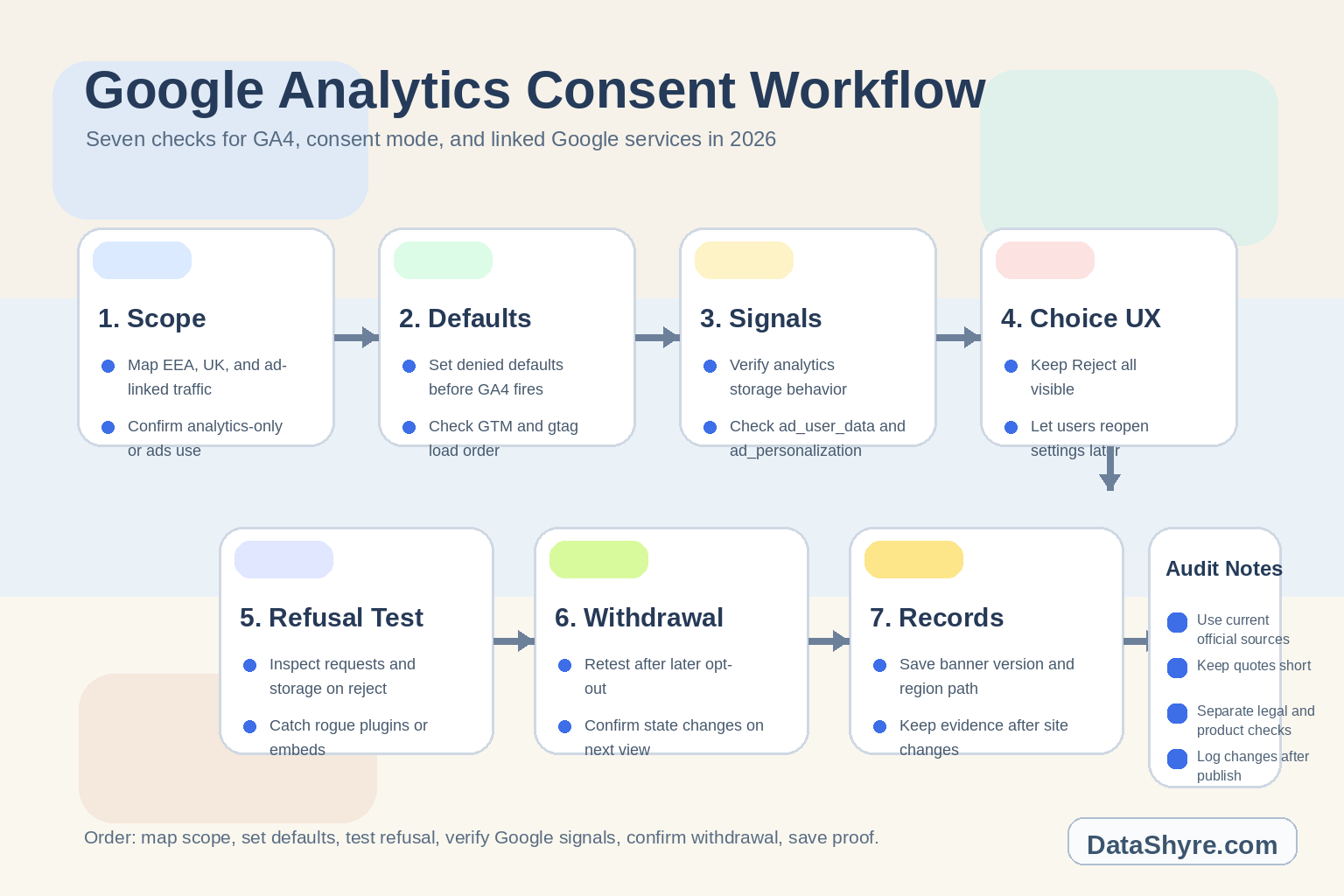
A practical review order for this week
If I were auditing google analytics cookie consent today, I would do it in this order:
- map every analytics-related storage point on the page;
- separate EU or EEA analysis from the UK’s narrow statistical-purposes branch;
- verify denied defaults load before any measurement commands;
- test rejection before acceptance;
- inspect linked Google services for
ad_user_dataandad_personalization; - review any documentation that still assumes Google Signals alone handles the ads branch;
- test refusal and later withdrawal again after a routine stack change;
- save proof another team can still verify next month.
That sequence usually tells you more than a long policy discussion about GA4 by itself.
FAQ
Does Google Analytics always need consent?
Not always in exactly the same way in every jurisdiction and use case. The better answer depends on region, purpose, configuration, and whether any narrow exception genuinely applies. For many commercial deployments, especially when advertising or linked Google services are involved, consent still ends up central.
Is Google Consent Mode enough by itself?
No. It is useful implementation plumbing, but Google’s own documentation says consent mode does not provide the banner or widget. You still need a valid notice, fair choice, correct regional logic, and runtime enforcement that matches the choice.
If analytics_storage is denied, is the job finished?
No. You still need to review what other scripts do, whether linked Google services require additional consent signals, and whether refusal or withdrawal is as easy and effective as acceptance.
Bottom line
In 2026, strong google analytics cookie consent is not a banner that merely mentions GA4.
It is a system that sets denied defaults early enough, respects regional differences, keeps linked Google-service requirements in view, stays honest when a visitor refuses, and preserves evidence another team can still use later.
For most teams, google analytics cookie consent becomes easier to manage once it is treated as an operating decision instead of a one-time banner task.
Sources
- European Commission, legal grounds for processing data: https://commission.europa.eu/law/law-topic/data-protection/information-business-and-organisations/legal-grounds-processing-data_en
- Google for Developers, set up consent mode on websites: https://developers.google.com/tag-platform/security/guides/consent
- Google for Developers, consent mode overview: https://developers.google.com/tag-platform/security/concepts/consent-mode
- Google for Developers, troubleshoot consent mode with Tag Assistant: https://developers.google.com/tag-platform/security/guides/consent-debugging
- Google Analytics Help, verify and update consent settings in Google Analytics: https://support.google.com/analytics/answer/14275483
- Google Analytics Help, obtain user consent: https://support.google.com/analytics/answer/14009343
- Google Analytics Help, updates to Google Analytics data controls: https://support.google.com/analytics/answer/17016975
- ICO, guidance on the use of storage and access technologies: https://ico.org.uk/for-organisations/direct-marketing-and-privacy-and-electronic-communications/guidance-on-the-use-of-storage-and-access-technologies/
- ICO, what are the exceptions: https://ico.org.uk/for-organisations/direct-marketing-and-privacy-and-electronic-communications/guidance-on-the-use-of-storage-and-access-technologies/what-are-the-exceptions/
—
Published: October 23, 2026. Updated using current official regulator, government, and platform materials available at publication time.